

If you're a successful tech product company, you can add SEP licensing claims to death and taxes as things that are certain. When, not if, these claims reach your shore, you must move quickly with an expert team to handle them. Like most problems, they only come back with interest if ignored.
You spent more than 15 years in Intel's IP and litigation groups, last as Vice President, Head of Technology & Innovation. How much of that time did you spend on litigation involving standard essential patents?
My work on SEP disputes began before Intel. At Kirkland, I litigated standards cases involving Wi-Fi and DOCSIS.
At Intel, SEP litigation was always a central part of our docket. Intel was at the centre of many major industry SEP battles. Those cases represented a significant share of Intel's multi-billion-dollar patent litigation docket and at times likely the majority.
Intel's CPUs and other components always contained many standardised technologies, many of which Intel innovated itself, including Instruction Set Architectures (ISAs), interconnect technologies such as Peripheral Component Interconnect Express (PCIe), USB, Ethernet, Wi-Fi, codecs and the like. Intel's SEP dispute profile expanded greatly after Intel acquired Infineon's baseband modem business in 2011, involving Intel in Wireless Wide Area Network (WWAN) technology during the peak of the "smartphone wars."
Explainer
- Standard essential patent (SEP): a patent protecting an invention that cannot be avoided when implementing a technical standard. A patent is "essential" where it is not possible on technical grounds to make or operate standard-compliant equipment without infringing it. (WIPO, "Standard Essential Patents")
- DOCSIS (Data Over Cable Service Interface Specification): an international telecommunications standard that enables high-bandwidth data transfer over existing cable-television (hybrid fibre-coaxial) infrastructure, allowing operators to deliver broadband internet alongside television. It is developed and maintained by CableLabs and was certified by the ITU. (ITU)
- Infineon modem business: Intel's 2011 acquisition of Infineon's wireless division explains how a semiconductor manufacturer came to carry significant exposure to cellular (3G/4G/5G) SEP disputes. Infineon was the baseband modem supplier for the original 2007 iPhone. Apple's iPhone first became directly involved in the "smartphone wars" in October 2009, when Nokia sued Apple.
The market is often described as having an "offensive" side, the "innovators," and a "defensive" side, the "implementers." Who is who and is this distinction fair?
The "big dollars" on the offensive side are driven by a very narrow set of companies. As a matter of volume, the offensive side also consists of many patent pools and other non-practising entities focused on generating licensing revenue from patents (often that they have purchased or licensed from the original patentees).
Most of the market is on the defensive side. These companies sell products and services so are targets for attack.
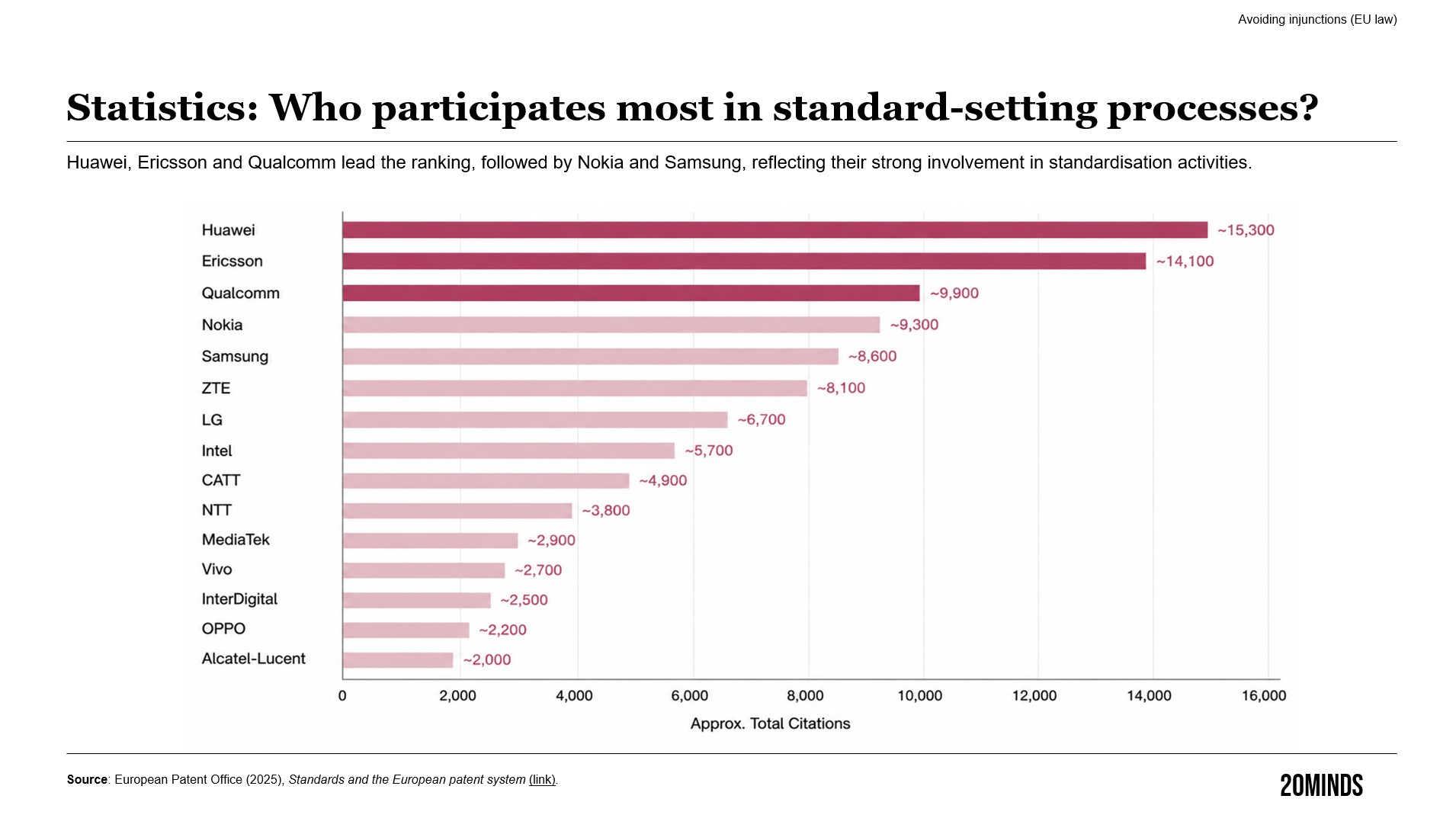
The "innovator versus implementer" label is too simple. Many so-called implementers are major innovators, patentees and standards-body participants. They invest heavily in technology and hold large patent portfolios of their own. Intel is one such company.
The real distinction is the companies' respective business models. Certain actors generate revenue by enforcing or licensing patents, while most companies generate revenue by building and selling products and hold patents mainly to defend themselves.
Explainer
- Patent pool: an entity that aggregates the SEPs of multiple owners and licenses them collectively under a single royalty. Pools function principally as licensing platforms that reduce transaction costs, allowing a licensee to obtain coverage through one transaction rather than negotiating with each holder individually; their role is not always unwelcome. (WIPO, "Patent Pools and Antitrust: A Comparative Analysis" (2014); US DOJ/FTC Antitrust Guidelines for the Licensing of IP)
- The "implementer versus innovator" characterisation: a contested policy framing, rather than a defined legal term, in which the small number of firms that monetise patents present the remainder of the market as mere "implementers" of the monetisers' patents. The distinction is often contested, since product companies are themselves substantial innovators whose products practice their own patents. (European Commission, Proposal for a Regulation on Standard Essential Patents, COM(2023) 232)
The rise of multi-technology products and services, e.g., connected cars, connected machinery, has further blurred the traditional distinction between "innovators" and "implementers." A company may be a licensor in one technology layer and a licensee in another. In such cases, reciprocal licensing relationships may better reflect how the ecosystem operates. (Editorial Note)
How are these patent portfolios built?
These portfolios are mainly built through in-house R&D. Some patents are acquired, but the core engine is internal development work.
The standards process is central here. When a new standard is being developed, members submit technical proposals. Those proposals often reflect technology the member has already patented or is trying to patent.
That process has often become deliberate. Companies send engineers to standards meetings. They track where the technical discussion is heading. They then file patent applications around the features likely to enter the standard.
In theory, FRAND commitments are meant to address the IP problems that can arise during standard-setting. They do so by allowing product companies to proceed with implementation on the understanding that, if they later need licenses to patents essential to the standard, those licenses will be available on fair, reasonable and non-discriminatory terms.
In practice, however, many of these IP problems are not resolved during the standardisation process. Patent enforcers may later set licensing prices after products have already been designed and launched; seek injunctions or exclusion orders based on FRAND-committed patents; and require product companies to commit to licenses at specified royalty rates before the asserted patents have been shown to be valid, actually essential to the standard, and infringed. These practices show how failing to resolve IP issues earlier in the standard-setting process can create serious downstream costs.
Explainer
- Technical proposal (contribution): a formal submission to a standards body regarding the design of a standard. Example (Wi-Fi): technology addressing multipath interference in wireless LANs, developed by Australia's CSIRO and protected by US Patent No. 5,487,069, was incorporated into the IEEE 802.11 standard (revision "a," 1999, and revision "g," 2003) and was subsequently litigated and licensed across the industry as a Wi-Fi SEP. (US Patent No. 5,487,069; CSIRO v. Cisco Systems, Inc., Fed. Cir. 2015)
- Standards bodies' IP rules can also shape SEP licensing outcomes ex ante. IEEE's 2015 patent-policy revisions, for example, limited the availability of injunctions for SEPs and introduced guidance on reasonable royalty determinations, including reference to smallest saleable patent-practicing unit concepts. The response to those changes illustrates the practical limits of standards bodies' IP rules: some technology contributors submitted "negative" Letters of Assurance, declining to license patents under the revised IEEE terms for standards such as 802.11. This shows that ex ante IPR rules can reduce uncertainty for implementers, but may also affect contributor participation if key patent holders view the rules as too restrictive.
What role do standards bodies play?
Standards bodies are allowed to exist as an exception to normal rules prohibiting competitors from collaborating because in this context it has been determined to be good for the consumer to have access to technology that works together.
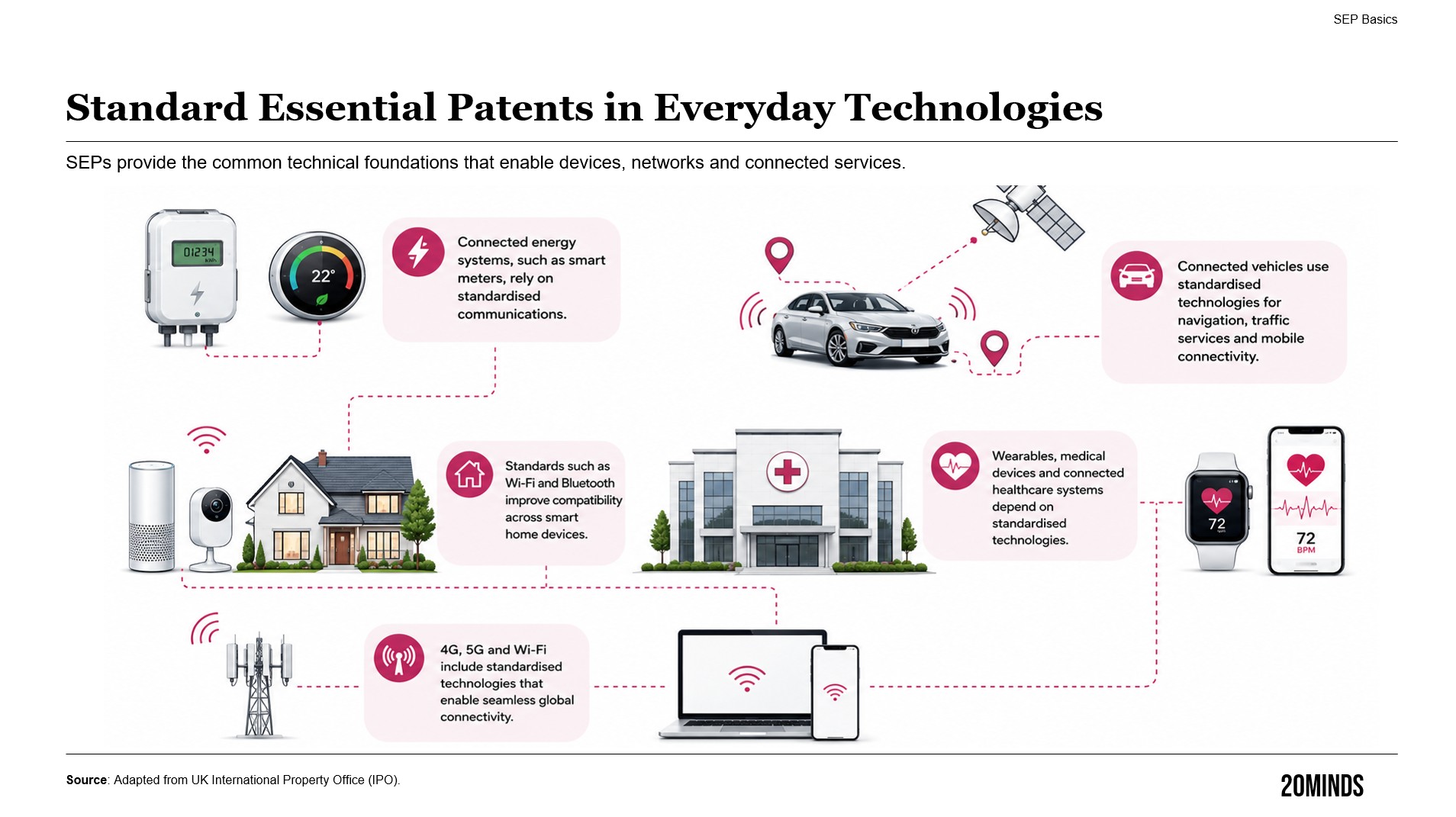
Bodies such as IEEE, W3C and IETF help ensure that devices, software and networks from different companies can interoperate. Wi-Fi works because products follow the same technical standard. The web works because browsers, servers and software follow common protocols. It sure beats the experience with power adapters when you're travelling abroad!
They are legal because standard-setting is usually procompetitive. It brings competitors into the same room, but the output can benefit the market: lower friction, wider adoption, better interoperability and more consumer choice.
Standards bodies set the participating technology. They do not set the royalty rate for licensing that technology. Understandably, they try to stay out of price-setting.
That is where the dispute begins. Some patent holders say FRAND still allows them to seek injunctions or demand very large royalties. Product manufacturers say that defeats the purpose of FRAND.
Explainer
- Standard-setting and competition law: an agreement among competitors to adopt a common standard is assessed under competition law (Article 101 TFEU in the EU; Section 1 of the US Sherman Act). Standardisation is recognised as potentially procompetitive, enabling interoperability, lowering costs and supporting innovation, but it can also raise concerns such as foreclosure of competing technologies, exchange of sensitive information between competitors and post-adoption hold-up. It is therefore treated as lawful where appropriate safeguards are met, rather than automatically exempt. Under the European Commission's Horizontal Guidelines, a standardisation agreement normally falls outside Article 101(1) where four cumulative conditions are met: participation is open, the procedure is transparent, there is no obligation to comply with the standard and the standardised technology is accessible on FRAND terms. Enforcement conduct, such as seeking an injunction on a FRAND-committed SEP, can separately engage abuse-of-dominance rules (Article 102 TFEU). (European Commission, Guidelines on Horizontal Co-operation Agreements (Chapter 7); CJEU, Huawei v ZTE, C-170/13 (2015); US DOJ/FTC Antitrust Guidelines for the Licensing of IP)
- FRAND commitment: as a condition of participating in the standards process, SEP holders are typically required to agree to license standard essential patents on Fair, Reasonable and Non-Discriminatory terms, the principal safeguard against a holder exploiting the dependency a standard creates. The precise obligation is defined by the relevant standards organisation's policy and can differ across organisations. Most commonly, patent holders are not required to identify what specific patents they hold that they consider to be standards essential and agree to license on FRAND terms. So, in general, companies building products implementing standards have no opportunity to evaluate third party patents until enforcement activity has begun.
- Hold-up (patent lock-up): once an industry has built products to a standard, migrating away becomes impractical, enabling a holder to advance disproportionate demands after adoption. "Hold-up" is the conventional term in the SEP literature; the FRAND commitment is intended to prevent precisely this outcome.
- Injunction (in the SEP context): a court order prohibiting the sale of an infringing product. Because the prospect of being unable to sell at all exerts considerable settlement pressure, the availability of injunctive relief to SEP holders is among the most contested questions in the field. Its availability varies significantly by jurisdiction and by the factual posture of the case, particularly where a FRAND commitment is in play.
Standard bodies are designed to select technologies. They avoid any royalty-setting discussions to preserve competition. This leaves courts and regulators with the task of "policing" the boundaries between legitimate monetisation and exploitative conduct. (Editorial Note)
Each side tells a different story about what the conflict is really about. Is there any common ground between these competing narratives, and could regulation help reduce tensions by addressing the concerns on both sides?
The two stories are hard to reconcile.
Product manufacturers targeted with patent claims say they should not have to pay until the patents are tested. They want to know whether the patents are valid, whether they are essential and whether they are actually infringed. The litigation statistics for SEPs that are actually litigated show that only a minority of asserted SEPs are in fact valid, essential and infringed.
Explainer
- Studies cited by the European Commission find that only between 10% and 50% of declared SEPs are actually essential (several industry studies put the figure at around 20–30%), so a substantial share of the patents underlying SEP-related claims may not be essential. (European Commission, Communication on SEPs, COM(2017) 712, citing third-party studies)
- Past empirical studies found that SEPs perform no better, and often worse, than ordinary patents in litigation, with only around 11–12% held both valid and infringed in US courts, high invalidation rates at the PTAB (73% of electronics SEPs fully cancelled) and widespread over-declaration meaning only 10–30% of declared SEPs are actually essential: see, e.g., RPX Corporation (2014), Standard Essential Patents: How Do They Fare?; Carrier & Nied, Seven Types of Standard Essential Patents AbuseABA Landslide (Oct 2025); Lemley & Simcoe, How Essential Are Standard-Essential Patents?, 104 Cornell L. Rev. 607 (2019), among others; though it should be noted that aspects of methodology of these studies has frequently been criticised.
Patent holders say that is delay. They argue that large portfolios cannot be litigated patent by patent before anyone pays. Their position is that, across a large enough portfolio, some patents will be valid and infringed.
That creates an arms race. Each side says the other side's rule would break the system.
Both sides are playing the incentives that the standard-setting system gives them. Once a standard is adopted, implementers have no practical way around the technology, which increases the leverage of SEP holders. But SEP holders also know that they cannot litigate hundreds of patents in court before anyone pays. (Editorial Note)
Regulation could help, but it cannot make the conflict disappear. The core dispute is economic. It is about who gets paid, how much and when. Rules can reduce uncertainty. They can create process. They can limit abuse. But they cannot remove the underlying conflict over value.
A fairer process would give both parties more room to negotiate and increase the chances of reaching a mutually acceptable outcome. At present, the threat of injunctions can force implementers to accept offers they do not agree with. SEP holders argue that injunctions are needed to bring unwilling implementers to the negotiating table, but that concern could also be addressed through less coercive procedural tools. (Editorial Note)
What forces have shaped SEP policy to date?
Policy has moved like a pendulum.
At times, regulators tried to tighten FRAND obligations and limit aggressive enforcement. At other times, they pulled back.
Large patent holders pushed hard against tighter rules. In the U.S., they argued that strong patent enforcement supports innovation, U.S. competitiveness and national security. That argument had political force.
In Europe, similar concerns were raised. It also has major patent holders and does not want to weaken its own technology champions.
The result is layers of rules; FRAND rules, patent rules, competition rules. The field has become extremely complex.
Courts have also shaped the system. Some courts became attractive places for SEP enforcement. That created forum competition. Patent holders filed where they thought they could get leverage.
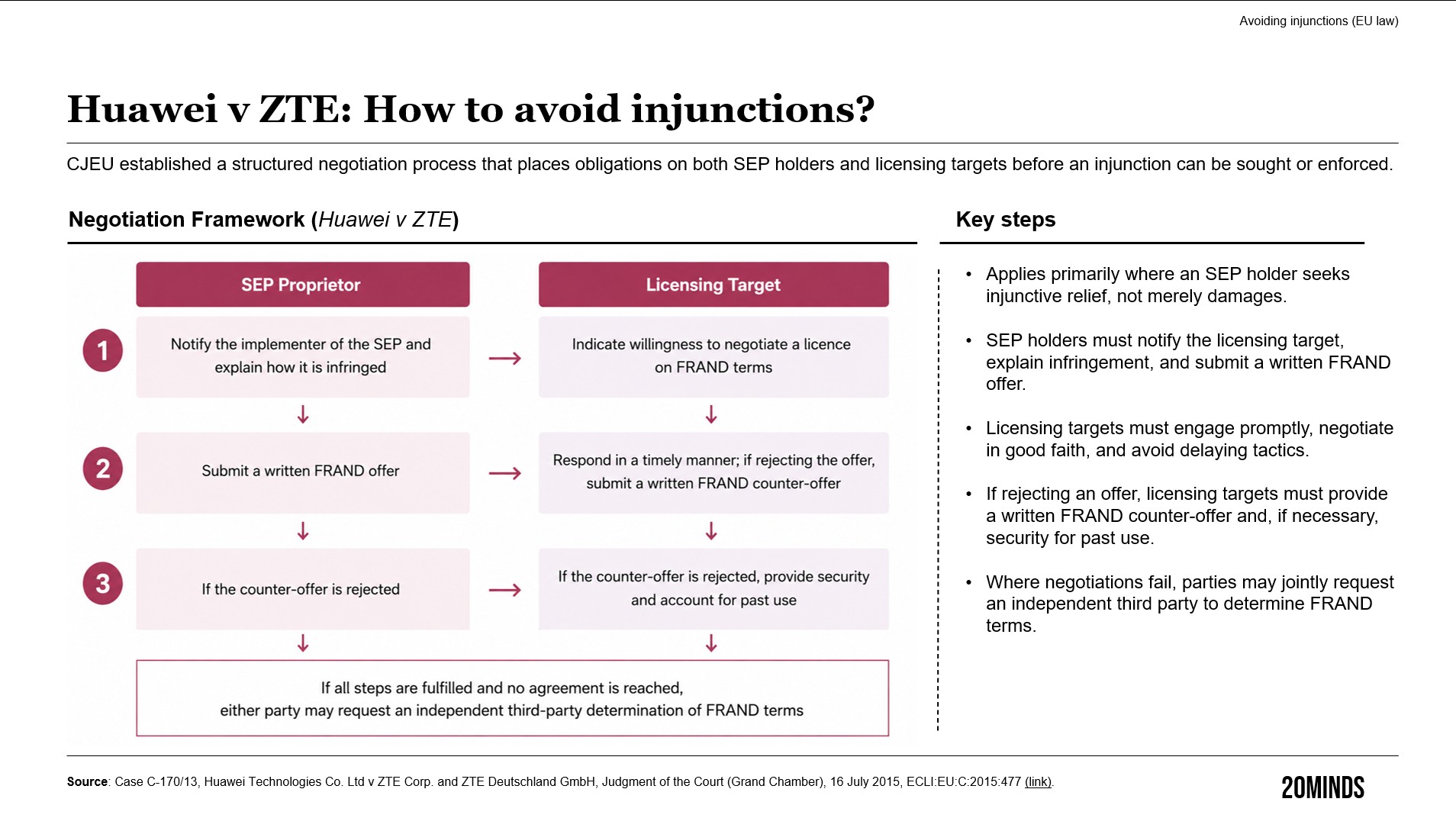
Example: German courts, in particular the Munich I Regional Court, have been attractive for SEP holders because they can grant injunctions relatively quickly if the implementer is found unwilling under the Huawei v ZTE framework.
That led to cross-border conflict. One court issues an injunction. Another court blocks that injunction. A third court may block the second court's order. The system becomes a stack of anti-suit and anti-anti-suit injunctions.
Underneath all of this is the real policy question: do SEP royalties help consumers by funding innovation or hurt consumers by taxing products? That question remains contested.
Explainer
- Anti-suit injunction (and anti-anti-suit injunction): an order by which one jurisdiction's court restrains a party from commencing or enforcing proceedings in another jurisdiction. The resulting manoeuvring across forums produces successive orders in which courts restrain one another's injunctions.
Companies should not view SEP disputes only through the lens of today's posture. In a standards-driven ecosystem, roles can be fluid: a firm defending against assertions in one technology generation may be a licensor in the next. Reciprocal licences and cross-portfolio dependencies mean that the strategy a company adopts today may shape the options available to it tomorrow. (Editorial Note)
A recurring complaint from defendants is that they are made to negotiate licences before the claimant has shown the patents are valid. Is that a fair description of how the process works?
Yes. In my view that is broadly fair.
The pressure comes from the threat of an injunction. If the target of an SEP patent claim does not engage quickly, the patent holder can say the party is an "unwilling licensee," which in several jurisdictions can result in the loss of antitrust defenses to later litigation injunction demands on FRAND patents.
The target may be pressured into accepting a licence it does not consider FRAND, especially where the alternative is withdrawing products from the market and litigating is financially too risky.
So, just on the receipt of a demand letter, the target can be pushed not only into negotiation but even irrevocable monetary commitments before any court has decided whether the patents are valid, essential or infringed.
That sequence can be a problem. The commercial pressure comes first. The merits come later. And often, when the merits are finally tested, many patents do not survive. Some are invalid. Some are not infringed. Some are not truly essential.
Explainer
- Validity, essentiality and infringement: three distinct questions: whether the patent was properly granted (validity), whether the patent is in fact necessary to practice the standard (essentiality) and whether the product in fact uses it (infringement). In ordinary infringement litigation a holder must establish liability in this way prior to any discussion of remedies; in SEP licensing disputes, however, a court may set FRAND terms or assess a party's willingness to license before every asserted patent has been finally adjudicated (see CJEU, Huawei v ZTE, C-170/13 (2015); Unwired Planet v Huawei [2020] UKSC 37). Defendants are frequently required to engage in negotiations before these questions are resolved and, though outcomes vary sharply by jurisdiction, forum and procedural stage, a substantial proportion of challenged patents ultimately fail on one ground or the other.
The patents in question are used primarily by the component maker. Why is the end-product maker often the target of litigation?
Claims follow the money. A finished handset, laptop or connected device has a much larger average selling price (ASP) than the chip or component inside it, even though the standard may be practiced entirely by the chip or component. That matters because enforcers target the ASP as the royalty base. Historically, end-product royalties got established early on in cellular patent licensing, and enforcers have fought hard to expand that model to other areas like Wi-Fi.
Ultimately the supply chain will be brought into the dispute. The company sued is the device maker, but the technical issue (and often the patent indemnity) sits with the supplier. So, the customer and supplier need to coordinate. Often, they must do that very early and before any formal indemnity obligation has been triggered.
In some cases, SEP owners impose non-disclosure agreements (NDAs) that prevent implementers from contacting suppliers or sharing relevant information with them, making supply-chain coordination very difficult.
Fortunately for the end-product maker, the supplier is usually better equipped. It knows the component. It knows the technology. And it may already have a SEP litigation playbook.
Legally, the key question is whether there is an indemnity clause that is valid and applicable to the situation. If the customer is indemnified, the litigation risk will shift to the supplier. If the customer is not indemnified, the customer's own business is at risk. But because there can be legal ramifications to pre-suit activities in SEP cases, often before formal indemnity obligations are triggered, close and early coordination between the parties is essential.
Explainer
- Royalty base and ASP: SEP royalties may be structured in different ways, some licences use a percentage of the end-product price, others a per-unit rate, and damages law often pushes toward apportionment, in places to the smallest saleable patent-practising unit. Where an end-product percentage applies, enforcers tend to assert against the highest-value saleable unit (the finished handset or laptop rather than the component) so as to maximise the base; the proper royalty base is itself actively contested. ASP denotes average selling price.
- Indemnification (indemnitor and indemnitee): a contractual undertaking, frequently given by a component supplier, to assume a customer's patent liability. Where it applies, the supplier, typically holding the relevant expertise and established procedures, often assumes conduct of the dispute. Indemnity may shift defence and liability, but it does not always eliminate business risk: scope, caps, exclusions, notice requirements and settlement-consent and control-of-defence provisions all determine how much protection it actually provides. Many indemnity provisions are only triggered upon an active suit or proceeding, not a licensing demand. However, in the SEP context licensing demands can trigger important legal requirements.
Beware that this is not simple patent litigation. To me, it is more like three-dimensional chess.
You have handled many of these cases for the defence. What does competent defence require?
These disputes are resource-intensive. They move fast. They usually involve many patents, many products and many jurisdictions.
This means you need to assemble a highly experienced team and prepare thoroughly.
While local expertise matters, every SEP dispute is, in practice, a global IP dispute. So, you need international counsel who know the relevant courts, the local procedure and the pressure points.
And you should start coordinating with your counsel and your supply chain (upstream or downstream) from the get-go. The first response matters. Even the first letter can push the company down a path that is hard to reverse.
Beware that this is not simple patent litigation. To me, it is more like three-dimensional chess. The defence strategy has to account for litigation, licensing, competition law, supply-chain risk, public positioning and cross-border remedies.
Make sure that your lead counsel has seen the full movie before, so that they know the usual playbook and know where the traps sit.
Where do competition regulators fit into a defence?
Initiating a competition law complaint with a relevant regulatory body is mostly a shield against claims. It is not usually the main defence, and litigation outcomes are typically faster. But competition law complaints can be a way to resist excessive leverage.
Of course, the complaint may be based on a genuine antitrust concern. Its tactical value, however, often lies in increasing pressure on the patent holder. If a regulator sends a request for information or opens an investigation, the risk profile for the patent holder changes. The issue is no longer just one licence or one lawsuit. The entire licensing programme may be under review.
That can rebalance the negotiation. The point is not to win on one front only. The point is to reduce leverage across the whole dispute.
Explainer
- Antitrust and SEPs: competition law sits on both sides of SEP enforcement. Because a FRAND commitment and a widely adopted standard can confer market power, conduct such as seeking an injunction against a willing licensee or demanding excessive or discriminatory royalties may amount to an abuse of a dominant position under EU law (Article 102 TFEU in the EU; the CJEU set out a negotiation framework in Huawei v ZTE, C-170/13 (2015)). In the U.S., comparable theories have been litigated under the Sherman Act: the district court found against Qualcomm in 2019, entering a broad injunction against its SEP licensing practices, before the Ninth Circuit reversed in 2020 and held that the FTC had not established an antitrust violation (FTC v. Qualcomm Inc., 411 F. Supp. 3d 658 (N.D. Cal. 2019), rev'd and vacated, 969 F.3d 974 (9th Cir. 2020)). For a defendant, the practical leverage is that a regulatory investigation can threaten the holder's licensing programme as a whole, not merely the outcome of a single patent case.
The competition-law process in the first jurisdiction may also help an implementer in a dispute elsewhere. This is especially true where that process requires broad disclosure. If the patent holder must reveal information about its global licensing practices and past negotiations, the implementer may gain evidence that improves its bargaining position and helps shape its defence strategy in the other dispute. (Editorial Note)
Why do many defendants seek a settlement of these claims?
Because certainty has value.
Many companies do not want an endless global patent fight. They want a number. Even if the number is painful, they can plan around it.
The precise amount may matter less than the fact of closure. A resolved claim can be budgeted. An unresolved global SEP dispute cannot.
That is the business logic of settlement. Pay the tax. Price it into the product. Move on.
The threat of an injunction against a flagship product can be existential. An adverse ruling may disrupt global sales, supply chains and the company's ability to meet customer commitments. (Editorial Note)
20Minds thanks Benjamin Yrun Ostapuk for his candid observations.
We also thank Julie Vandenbussche, Scott Rissmiller, Smita Andrews and other 20Minds members for their editorial advice.