


.jpg)


Introduction
Lawyers operating across jurisdictions are not a new phenomenon. Lawyers have crossed borders for centuries: Roman jurists advised across the empire, canon lawyers moved between medieval universities and courts, and colonial lawyers carried legal systems across continents. International bar associations emerged as early as the late 19th and early 20th centuries.
What is new is the scale and the expectation. Global companies, cross-border regulation and international law firms have created a generation of lawyers whose careers are no longer tied to one jurisdiction alone. Today, transactions, compliance systems, investigations and disputes routinely stretch across borders, allowing lawyers to operate between legal systems, cultures and languages.
Yet law remains a deeply local profession. Qualifications are national, regulation is territorial and legal culture does not travel as easily as finance or technology. A corporate lawyer moving from São Paulo to London, or from Vienna to Dublin, often discovers that the challenge is not only learning a new system but persuading others that experience acquired elsewhere still counts.
That tension, one could argue, has produced a new kind of professional: the “portable lawyer”. These are lawyers whose value lies not only in technical expertise but in the ability to translate between jurisdictions, manage uncertainty and orchestrate advice across borders. Some move through secondments or internal transfers; others rebuild careers from scratch after relocation. Many describe the experience less as a clean upward progression than as a negotiation between ambition, identity and adaptability.
The lawyers interviewed for this article took very different routes across borders: from Brazil to Italy, from local to regional, within an economic bloc (EU). Some moved for opportunity, others for family or curiosity. Some lost seniority; others did not. But their stories reflect the same underlying shift: from practising law inside one system to learning how to operate between several.
Nathalie Neumayer
Austria → Ireland · For personal reasons · Mid-qualification, LLM in Scotland, with a detour through compliance

You moved for personal reasons and before qualifying as a lawyer. Where exactly were you in the process?
I was midway through the Austrian route to qualification, which is a long one. After my first degree, I had already completed the elements that could count towards qualification: working at court, an LLM and two years at a university. But I had not yet completed the two years in a law firm.
That was the piece I was missing when I moved to Ireland. So I arrived with a great deal of legal background but without a completed qualification in either system.
How hard was the transition in practice, and how did you become a barrister?
The transition was harder than I had expected. I was perhaps a little naive. I thought all those legal studies, plus a master’s from Scotland, would be enough to find something relatively easily.
It was not easy. Initially, everything I was offered was essentially a graduate role. So rather than start at the bottom of the legal food chain, I pivoted into compliance, worked there for quite a while and qualified as a barrister at weekends. I have since transferred within the same company into the legal department.
Are you now where you would have been if you had done it all in Ireland?
I do not think I have reached the same level yet, but it is not dramatically far off. It is close enough that I do not regret the decision.
Your academic work in Austria — did this count at all?
In civil law systems, there is real cross-fertilisation between academia and practice; in common law, the two feel much more distinct. Ireland has a common law system. I believe my two years working at a university were almost seen as a detour rather than something that added value.
Strong research skills count for slightly more in the barrister profession, which in Ireland is still traditionally the researching “lone wolf” doing the advocacy and all the research supporting it, largely by herself, but not so much for the in-house corporate path.
If you were the hiring manager, how would you help foreign talent settle into the new role quickly?
A key priority would be to introduce that person to the local legal network. Coming from abroad, you may not yet have contacts in local law firms, for example. As an in-house lawyer, you need those relationships to be effective.
What’s your advice to the next generation?
Be intentional about your international career. Being an expat and living in another country come with real downsides too. This is not for everyone. You have to know what you want before you commit to it.
Ana Flávia Azevedo Pereira
Brazil → Europe · Her own initiative · Planned deliberately over roughly three years

Your transition stands out because you moved the furthest. How did you prepare for the move?
Long before I left Brazil, I had decided to internationalise my career and worked towards it quite deliberately: studying languages, completing a master’s degree, undertaking research stays in different countries and even asking my employer at the time to send me on a secondment to a partner law firm abroad, which happened to be based in Italy. Each step helped make the transition possible. But, of course, preparation was only part of it — timing, luck and people willing to take a chance on me also mattered.
So why do many people lose seniority when they move — and do you think they should?
Many lawyers I know did take a few steps back in seniority after moving to a new jurisdiction, regardless of whether they chose to work in law firms, consulting firms or in-house roles. But often that was not because their skills did not transfer. It was more a question of whether hiring managers could recognise how transferable those skills were.
In my own case, things changed once my manager saw my work and felt I was ready for the next step. Interestingly, after my first professional experience in Europe, recruiters started reaching out to me on LinkedIn with opportunities corresponding not to my current title but to roles one, two or sometimes even three career steps ahead. Other international lawyers have described a similar experience: their overall career trajectory and total years of experience began to be perceived differently after securing their first position in Europe. It is almost as if obtaining that initial role functions as a form of institutional validation for all the professional experience accumulated before relocating.
However, catching up in title and seniority is often far more difficult in law firms. Law firms tend to be more conservative environments and the legal profession is heavily regulated. Requalification requirements, practice restrictions, bar association fees and additional training obligations imposed on international and European lawyers can create structural barriers that place foreign-qualified professionals on a slower, narrower and more uncertain career path.
Furthermore, proficiency in the local language can be a significant limiting factor, understandably so. Clients expect their lawyers to communicate with precision and fluency, and language is ultimately the lawyer’s primary working tool. As a result, grammatical mistakes or linguistic imperfections, even when speaking in a second language, may sometimes be perceived as a proxy for weaker technical competence. International lawyers are therefore required to perform at an exceptionally high level in a non-native language from the outset.
You go further than that — you say experience and training in a more unstable environment can be an advantage. Why?
I think it can be. A background in a more volatile or complex environment, for instance in an emerging economy, is not necessarily a handicap. Lawyers who have built careers in less predictable conditions often learn to improvise, manage crises, remain resilient and flexible, and work with ambiguity and uncertainty.
As the world becomes more unstable, those experiences may be valued more highly, especially by large companies and law firms exposed to geopolitical instability or operating in emerging economies. What once looked unusual on a CV can become a strength.
Seen from the other side of the table, what do you look for when you’re the one hiring?
I assume most law schools, wherever they are, try to build broadly similar foundations. Law students everywhere are generally trained to interpret rules, structure arguments, analyse facts and reason carefully under uncertainty. What matters to me is judgment and critical thinking: whether the person asks good questions and, crucially, whether they understand the limits of their legal knowledge.
What’s your advice to the next generation?
Test the idea of moving abroad early and, once you decide to do it, commit to it for the long haul. Building an international career usually requires consistent effort over many years. It is rarely the kind of achievement that happens overnight.
Get some exposure to living abroad — even through a short language course — to make sure it is really what you want. Ask yourself whether you are willing to accept the sacrifices involved or whether you may be romanticising the idea of living abroad. Once you decide, go in with realistic expectations. This is not only a change in lifestyle; it is also a change in who you are. Four years on, I still feel the adaptation process is not finished.
Robert Kretzschmar
Secondment from Germany to Hong Kong and the U.S., then a European (later international) team led from Frankfurt · International reach without full relocation

Your international move came later than the others’. How did this come about?
My ticket to a secondment by the law firm I was working for at the time was IT contract law — a specialism that is not heavily jurisdiction-dependent. I was seconded to Hong Kong and to the U.S., two jurisdictions that are quite different from the jurisdiction I had studied and was familiar with (Germany). Later on in my in-house career I was given management roles covering more and more countries over time.
What was the hardest part of working in a jurisdiction where you were not qualified?
You can no longer rely solely on your own legal skills; you have to learn to rely on others. That is deeply unfamiliar after long training, where you become highly skilled — but, in my case, in German law rather than Hong Kong law and the other jurisdictions that followed. It feels a bit like having an arm cut off when you can no longer confidently answer legal questions yourself.
The danger is that people then apply what they think is common sense, when in fact it is the principles of their home jurisdiction — and those may not fit.
In leadership roles, there is a risk of paying a “translation tax”: too much senior time goes into coordination rather than substance. Across three regions and time zones, the balance is delicate: over-empower local leads and you lose integration value; stay in every loop and you become the constraint. You also need to guard against quiet attrition among strong local lawyers who feel managed by someone who does not really understand their market.
That sounds like a lot of challenges. Is there an upside?
You learn to collaborate closely with the people who know the local law. You learn humility. And in my later roles — which were more about gaining geographical reach and rotating leadership roles — I made a real shift: from giving advice to orchestrating advice. That is its own skill, and it requires a ramp-up period. It is not for everyone, but it is work I enjoy, and it has enriched me.
How do you weigh a local candidate against an international one?
It depends on the role. For a purely local role in an area that requires local knowledge — labour law, say — with no management component, I would go with a local candidate.
But for anything more international in the law it covers, more jurisdictionally flexible, or any management role, I would prefer the candidate with international experience. On the soft-skills side, you tend to get more humility, more flexibility, courage to take risks, developed cultural intelligence — a more rounded personality, which matters enormously for leadership.
On substance, they are also better practised at separating industry norms and market practice from actual legal requirements — a discipline that is hard to acquire in a single jurisdiction.
How can international experience contribute to the quality of the in-house function?
I once worked on a global contract template overhaul project for a US-headquartered company. The usual approach would have been to build a US-law template and then localise it. That would have left local lawyers merely defending each change they made to the template. The push for “global consistency” often leaves no one fully satisfied: HQ sees too many deviations, while local teams feel the localisation does not go far enough or fit the local market well.
My company chose a different path. It put international colleagues (inter alia from Brazil and Germany) on the task of leading the effort. That meant no US-law template, but a global artefact deliberately detached from the culturally dominant jurisdiction. The result was a truly global starting point for localisation — more inclusive, and probably better.
Leaders need to be careful: templates and policies led from one dominant jurisdiction can quietly drift toward that jurisdiction’s defaults. Awareness of cultural and legal differences, strong listening skills, and jurisdictionally diverse teams are essential.
Is there a skill you wish had been part of your own training?
Comparative law. Someone qualified in one legal system and someone qualified in another will struggle even to speak to each other without some knowledge of the other system. So wherever comparative law input is needed, I would always prefer the candidate who brings that perspective in one CV.
AI is now helping a lot to get your head around this discipline without years of studying different legal systems. However, good results still require the lawyer’s curiosity, respect for unfamiliar legal concepts and historical contexts, and an unbiased grasp of both differences and commonalities.
How do you assess the quality of a candidate’s background beyond that?
I am not very impressed by the greatest universities someone has attended — especially when you are hiring into a team rather than looking for an isolated expert.
Personality is really key, and you only find that out in a human-to-human conversation. It need not be a tough interview full of tricky questions; it is the normal conversation between professionals, where you sense the fit, the tacit knowledge, judgment and communication skills the candidate brings, how honest the CV was, and how naturally the person comes across.
With AI taking an increasing share of the technical skill component, you want the human skills to be the deciding factor.
Your advice to the next generation?
Avoid the mistake I made: I was not intentional about looking beyond the borders of my comfort zone — my home jurisdiction. I was lucky that people pushed me onto rotations and gave me international roles. If I could turn back time, I would be more intentional and not count on luck.
But know yourself, too: it is not for everyone. There are excellent local lawyers, possibly more valuable than any global leader in terms of their depth of expertise, who simply may not be a fit for cross-border roles.
And one more caution: for the most part of my career, I ran things from Frankfurt rather than relocating, and that brings remote-management and time-zone related challenges on top of the intercultural ones. Either way can be challenging— relocating, or staying home and managing lawyers across jurisdictions remotely.
Finally, I believe that everyone in regional management roles should maintain their technical legal skills and remain capable of digging into local law issues rather than operating at 30,000 feet all the time. Staying hands-on with German and EU law over my entire career helped me transition into my current role as external counsel.
What other 20Minds members observed
20Minds asked members who had made a comparable cross-border move where they went, how it affected their careers, and what they would advise others considering the same decision.
The sample is small and self-selected, so the findings are indicative rather than representative.
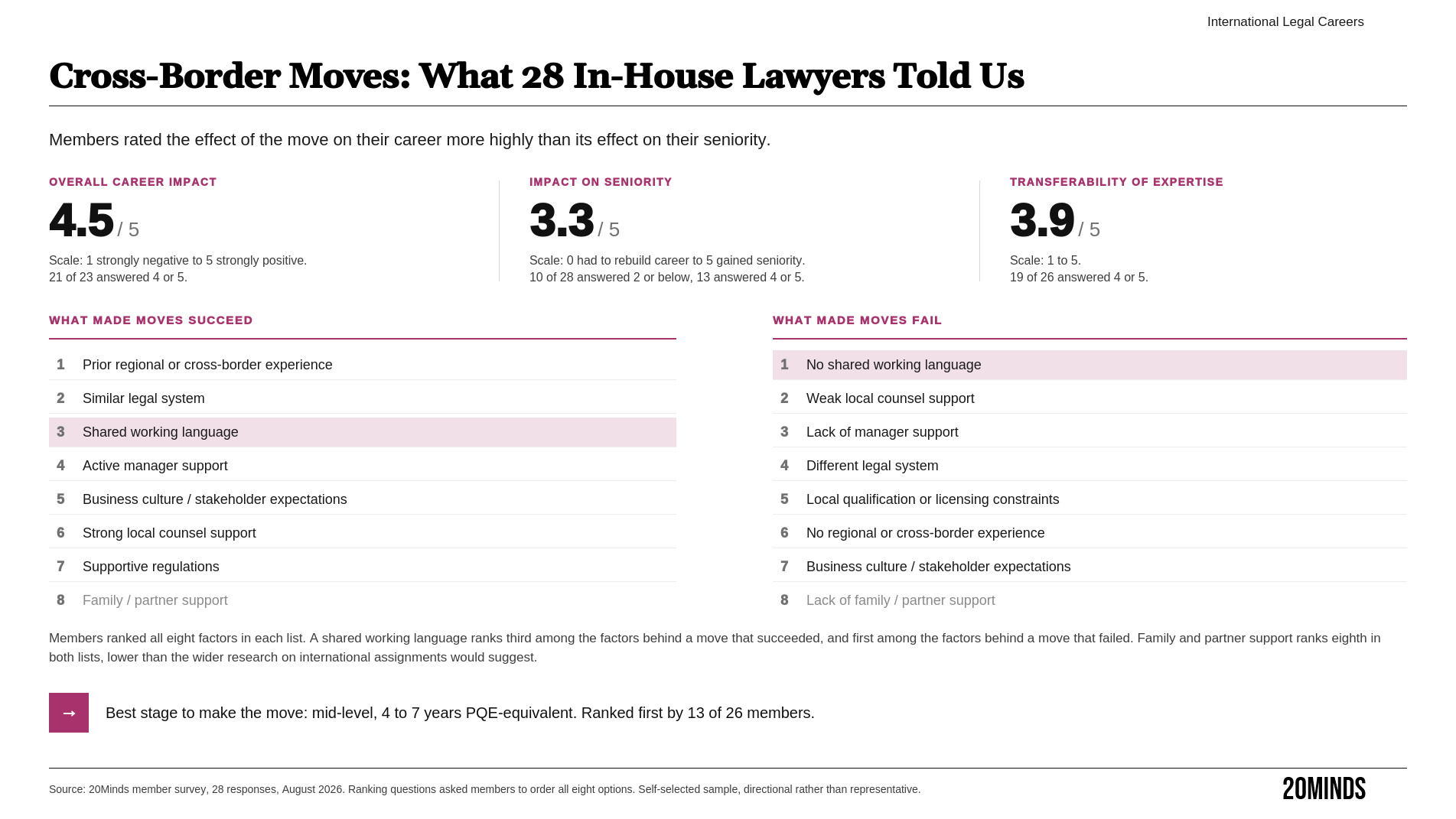
Direction of moves. Most moves were within Europe, while the Middle East and Gulf appeared mainly as destinations. Commercial and contracts work was the most common practice area, suggesting that work tied less closely to a single body of local law is more portable.

Try to understand the general differences in the jurisdiction rather than the specific subject matter, and find someone who can support you on the geopolitical context, whether in legal or in public affairs. Understand from the beginning what the main differences are with the jurisdiction you are used to, or in which you were trained. (Ana Garcia)
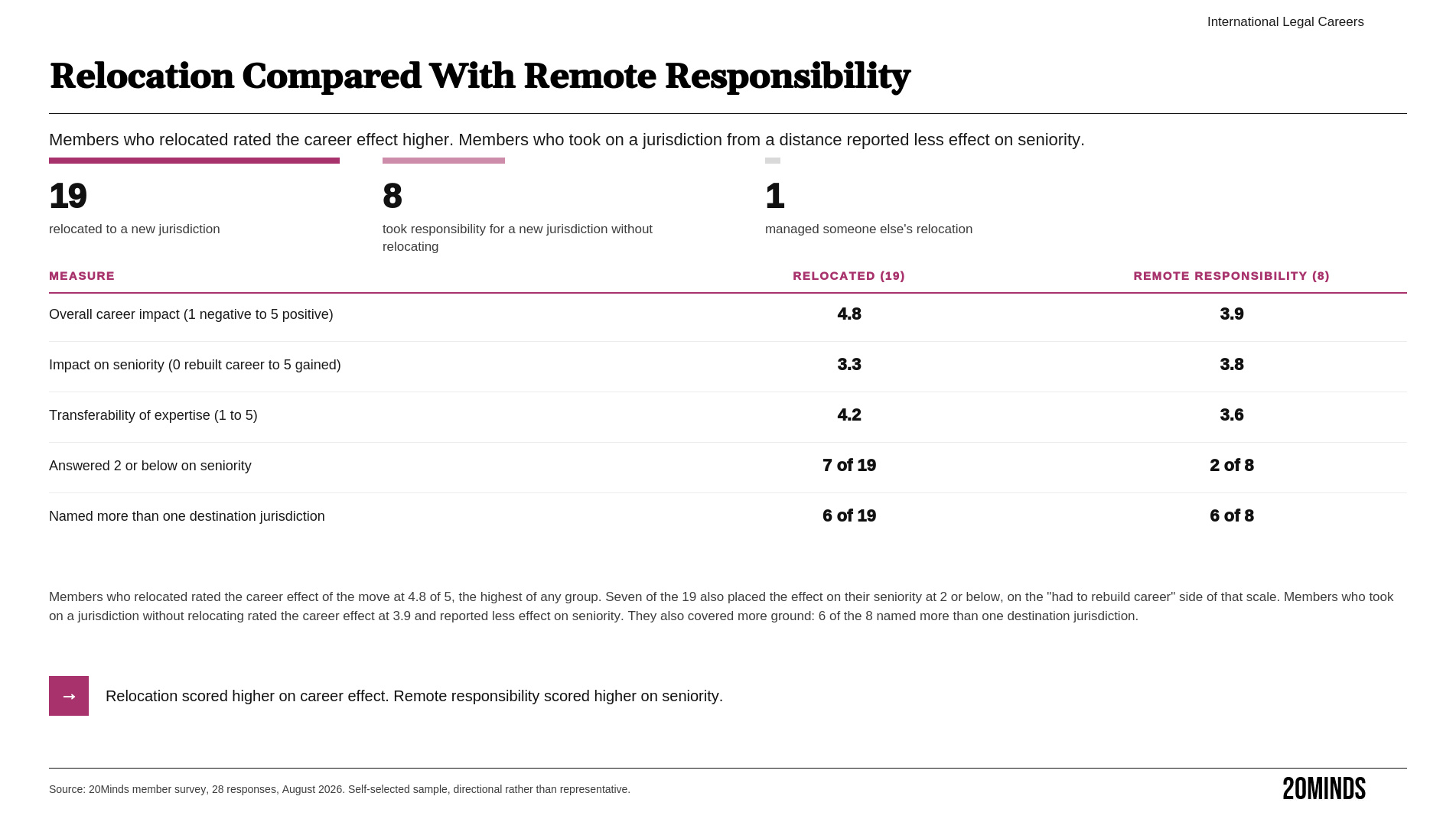
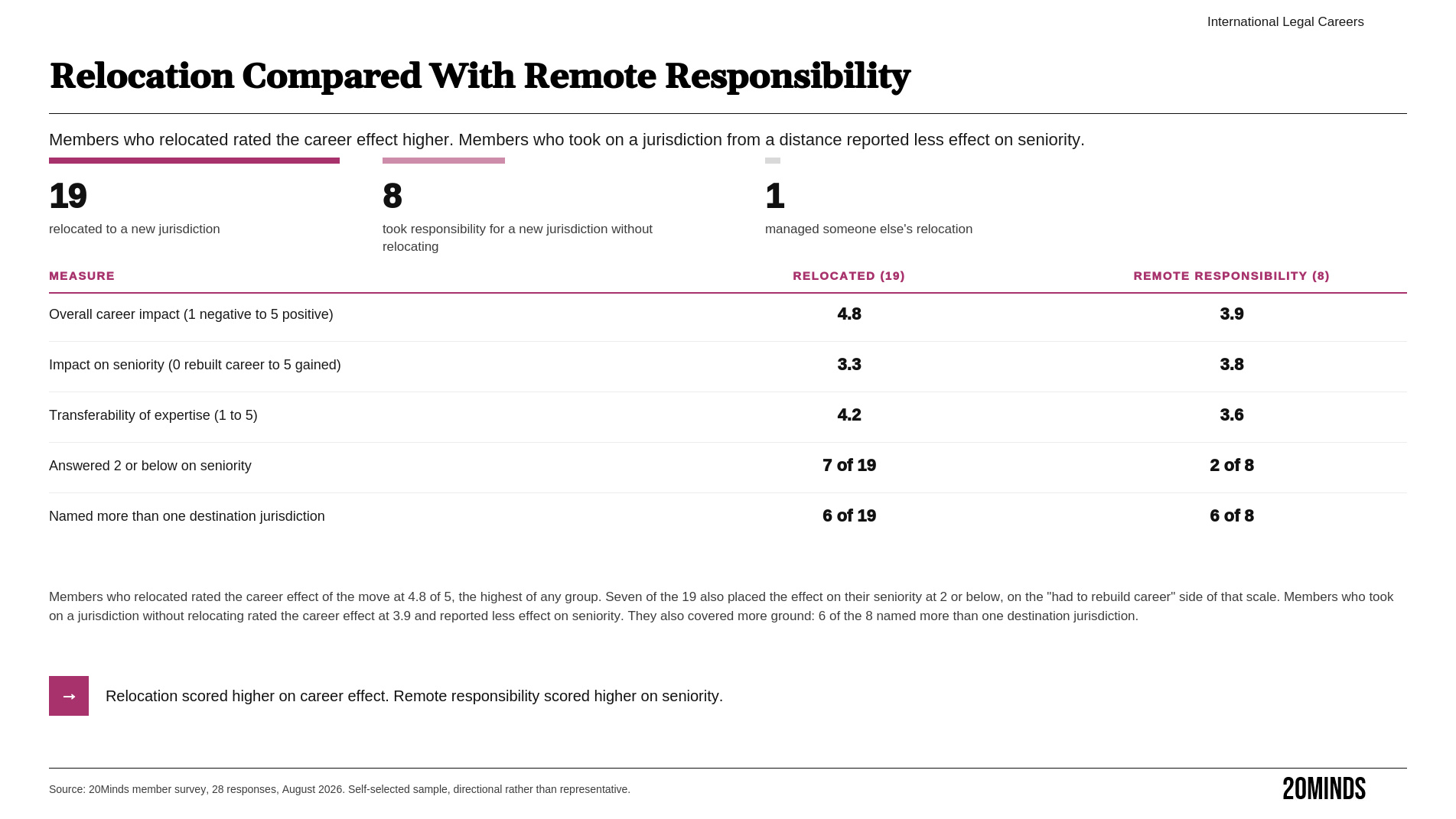
There are two ways to cross a border. Most respondents relocated; a smaller group took responsibility for new jurisdictions without moving. Relocation was associated with a stronger career effect, but also more disruption to seniority. Remote moves had a smaller career effect but often covered more jurisdictions.
Focus on internal reputation over quick wins. Build relationships with key stakeholders, because their trust may determine your influence more than your technical skills do. (Spencer Davis)
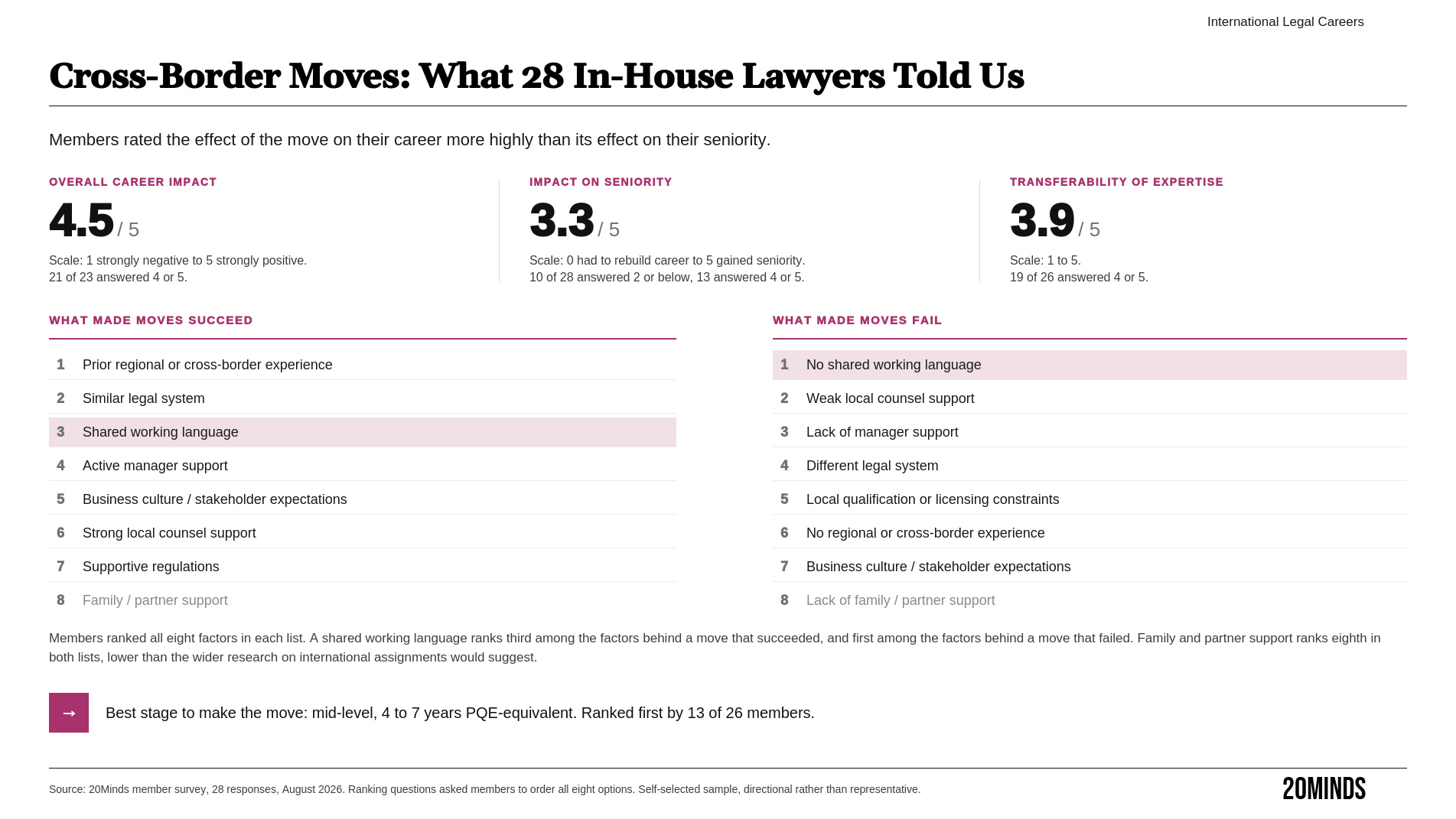
Career impact and seniority. Most respondents viewed the move positively overall, but the effect on seniority was more mixed. Expertise generally transferred more easily than title or rank.
Take the move, especially if it is a step up. You do not get many chances in-house because the opportunities are limited, so when they come, go for it. (Sameer Karimbhai)
What makes a move work. Prior cross-border experience ranked highest among the factors associated with success. Language, local counsel and manager support were among the most important factors when absent. Mid-level lawyers, around 4 to 7 years PQE-equivalent, were most often seen as being at the best stage to move.
There will be a massive gap in your legal knowledge. Do not be afraid to learn from any source available. Always cross-check your advice against the local position and double-check that your legal judgment is sound. (Sonja Dunne)
Do not be afraid to speak up and ask dumb questions. (Clemens Canel)