


HR practices have moved into the spotlight of antitrust enforcement — not only in the U.S. but also in Europe and other parts of the world. They should be high on the agenda for antitrust compliance trainings; HR functions must also be trained to create awareness in their teams.
What antitrust risks can arise from HR practices?
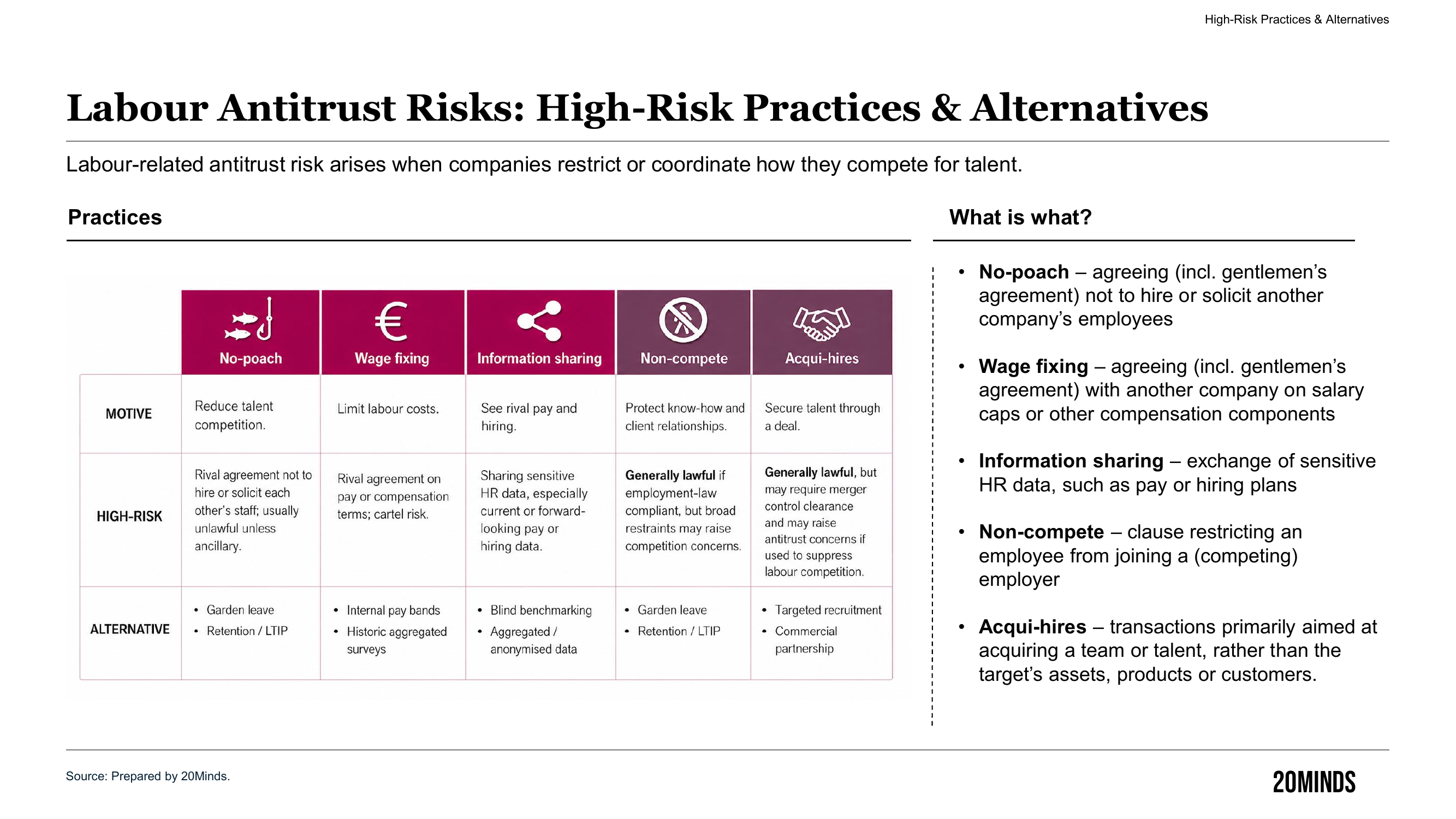
Anna: The highest antitrust risk arises from wage fixing and no-poach agreements. These are generally treated as hardcore restrictions and, in most cases, qualify as clear-cut infringements, subject only to narrow exceptions (for example, where strictly necessary and proportionate in the context of a legitimate joint venture).
- Wage fixing: agreements not to compete on compensation (salaries, bonuses, benefits, pay increases). Effectively the labour market equivalent of price fixing.
- No-poach agreements: commitments not to recruit, solicit or hire each other’s employees (including both non-solicitation and non-hiring).
These arrangements do not need to be documented in writing to create issues. Informal understandings and tacit coordination can be sufficient to result in penalties.
On 30 April 2026, the Court of Justice of the European Union, the EU’s highest court, issued its first ruling on no-poach agreements between competing employers, confirming that they, as a rule, qualify as restrictions of competition by object under Article 101(1) TFEU.1 This matters for employers because, for by-object infringements, authorities need not prove actual anti-competitive effects; by-effect cases require evidence of actual or potential harm and are harder to establish. However, the Court did not make the rule absolute. It left room for no-poach agreements to be assessed (by the European Commission and regulators or courts in the Member States) by effects where a concrete review shows why by-object classification would be unjustified. (Editorial Note)
A related risk is information sharing. Exchanges of HR data, such as compensation levels or incentive structures, are particularly sensitive where the information is current, granular and company-specific. Risk increases with the level of detail and the way the exchange is structured.
Beyond this, two areas are receiving increased scrutiny: non-competes and acqui-hires. These are not per se unlawful but require case-by-case assessment.
- Non-competes: restrictions on employees joining competitors post-employment. Assessment turns on duration, scope, and necessity, and may arise under both labour and competition law.
- Acqui-hires: acquisitions primarily aimed at securing talent. While not a formal legal category, they may raise concerns where they remove potential competition or affect labour market dynamics, including under merger control.
The highest risk is usually in horizontal arrangements, i.e., agreements between actual or potential competitors. Examples: two competitors agree not to hire each other’s employees; a group of competitors agree to cap wages or benefits; during a conference, two competitors share sensitive salary or hiring plans with the tacit understanding to not increase salaries or headcount in the future. The risk may be lower where the restriction is linked to a genuine commercial arrangement, such as an outsourcing or consulting agreement, rather than being a standalone agreement between competing employers. In that context, the restriction may be considered “vertical” or “ancillary”: it supports the main business relationship and is not the main purpose of the agreement. To reduce risk, it should be necessary, proportionate and limited in scope and duration. (Editorial Note)
HR is becoming a strategic antitrust risk area and a “core” function, such as sales or other functions exposed to antitrust risks.
There are fewer enforcement actions on HR practices than on price-fixing, abuses of dominance or mergers. Is antitrust scrutiny of HR practices a secondary concern?
Julie: Historically, HR practices have indeed not been a priority area for antitrust enforcers. But that may be changing now.
It is worth looking at the United States, which is ahead of Europe in applying antitrust law to labour markets.
In the US, this has been an enforcement focus for more than a decade:
- In 2010, enforcement actions were brought against major technology companies, including Google and Apple, in relation to no-poach arrangements.
- From around 2020 onwards, US authorities moved towards criminal enforcement, with the first prosecutions for wage fixing and no-poach agreements (albeit with mixed outcomes in court).2
EU enforcement remains more limited but is evolving. Some of the most visible cases to date have arisen in professional football.
Example: In FIFA v BZ (Case C-650/22), the Court of Justice of the European Union found that certain aspects of FIFA rules governing the international transfer system infringed EU law, as they restricted competition between clubs and hindered the free movement of players.
Until recently, the European Commission had issued no standalone decision addressing labour market agreements. That changed in 2025 with the Delivery Hero / Glovo case (Case AT.40795). The Commission sanctioned the companies for conduct including a no-poach agreement, the exchange of commercially sensitive information, and broader coordination. It was the first EU-level decision of its kind.
Labour-market-focused enforcement is also becoming more visible outside the EU and the U.S. For example, the Turkish competition authority has investigated HR-related conduct across several sectors, including pharma, and imposed administrative fines. Canada has adopted provisions making wage-fixing and no-poach agreements a criminal offence.3 Generally speaking, enforcement intensity varies over time depending on legislative developments, agency priorities, court outcomes and changes in political administration. (Editorial Note)
What is the rationale for enforcement, and how difficult are these cases to prove?
Anna: The economic rationale for enforcement is well established:
- Wage fixing can suppress wages and negatively affect economic output.
- No-poach agreements reduce employee mobility and can lead to inefficient allocation of talent, as employees are prevented from moving to more productive roles.
- Where such practices exist, companies may have reduced incentives to invest in their workforce, with potential longer-term implications for innovation and overall economic performance.
As for detection, the Delivery Hero / Glovo case is instructive. While the relevant evidence emerged in the course of an unrelated investigation, once found, the evidence seemed relatively clear from the European Commission’s perspective.
By contrast, information sharing cases are typically more difficult to detect and prove, as they often rely on more indirect evidence and require a detailed assessment of the nature and effects of the exchange. That said, the risk of enforcement remains real, particularly where complaints or whistleblowers trigger regulatory scrutiny.
The difficulty of proving a violation depends also on the applicable legal standard. Wage-fixing and naked no-poach agreements are generally more straightforward to characterise as serious restrictions of competition by object. In such cases, the central evidential challenge is therefore proving the existence and scope of the agreement or understanding. (Editorial Note)
What steps, if any, should companies take in this environment?
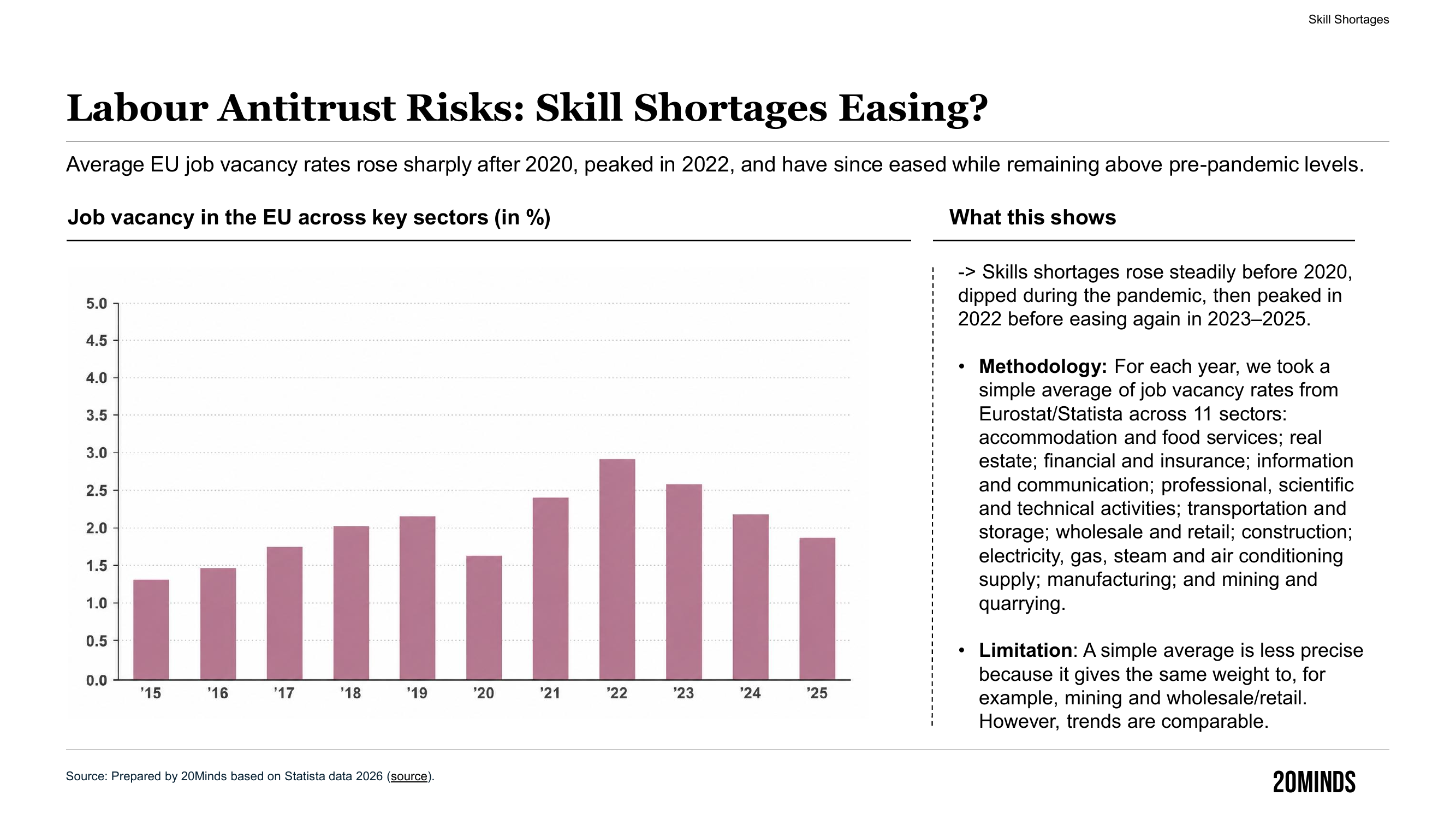
Julie: Companies should take this area of compliance seriously. Risk should not be assessed solely by reference to the current number of cases. Enforcement remains relatively limited, but the direction of travel is clear. Authorities are increasingly focusing on labour markets as a distinct area of competition law, informed by broader concerns around wage growth and labour mobility. This is driving an expansion beyond traditional enforcement areas.
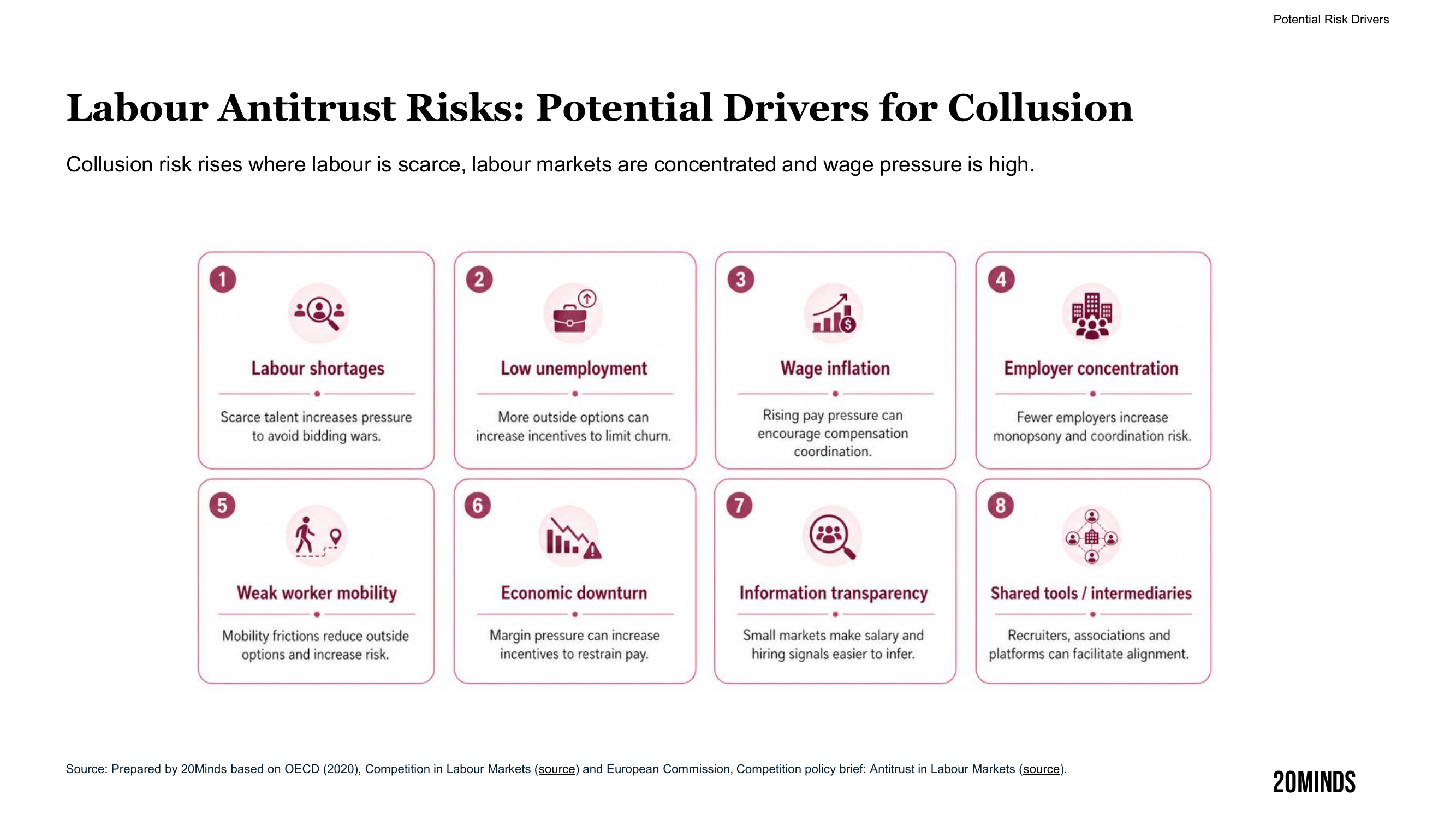
When prioritising, companies should focus on where risk is most likely to arise. This is often driven by the characteristics of the talent market:
- Scarcity and specialisation increase risk.
- The availability and interchangeability of talent are key indicators of how closely employers compete.
Highly specialised roles — such as in technology or other knowledge-intensive sectors — may require a more tailored compliance approach than more general functions.
Anna: Structural market features can also affect risk. One relevant factor is salary transparency, although its impact is not one-directional. In some sectors, compensation levels are widely visible.
The legal sector is one example, where associate salaries are often publicly reported and closely tracked.
In other areas, such as support functions, compensation is typically less transparent. Lower transparency does not reduce risk. These roles can still form highly competitive labour markets, and antitrust authorities will seek to protect competition for talent across all functions.
Upcoming pay transparency and gender pay gap rules in EU countries may also affect how compensation information becomes available and how companies manage related competition risks. Greater legal transparency does not remove the need to avoid improper exchanges of competitively sensitive non-public information. (Editorial Note)
No-poach arrangements, like wage-fixing agreements, are generally illegal. However, businesses have a strong interest in protecting their know-how from being taken to a competitor. What are lawful alternatives to no-poach arrangements?
Anna: Individual non-competes can be an alternative and should be clearly distinguished from no-poach agreements.
No-poach arrangements involve coordination between competitors and are typically treated as hardcore restrictions. By contrast, non-competes are agreements between an employer and an employee. They do not involve coordination with competitors and are therefore assessed differently from an antitrust perspective.
In principle, non-competes allow for individual negotiation, including on compensation and duration. In many jurisdictions, compensation during the restricted period is required, and the scope and length of the restriction are subject to statutory limits.
Subject to national labour laws, non-competes can be lawful and may offer a degree of protection for employers’ know-how. However, they are not risk-free. Overly broad, long, or systematically applied non-competes may restrict labour mobility and attract scrutiny.
Julie: There are also other mechanisms that may help retain employees without creating the same level of antitrust risk. One example is a training repayment clause, requiring reimbursement of training costs if an employee leaves within a defined period. Such clauses usually must be proportionate and linked to actual costs to be enforceable.
However, enforcement in this area continues to evolve. Even arrangements that are currently considered lower risk may come under closer scrutiny. Companies should therefore apply these tools carefully and in a targeted manner.
Employers may have legitimate concerns about former employees moving to competitors with confidential information, proprietary know-how or trade secrets. Those can often be addressed through targeted confidentiality, IP, trade secret or narrowly tailored restrictive covenant protections. (Editorial Note)
What are the rules on sharing employment-related information with competitors?
Anna: Salary information is competitively sensitive, in particular if it is current or forward-looking and particularly where salaries are the result of individual negotiations, e.g. C-Level management as opposed to more standardized blue colour wages in some sectors. As a rule of thumb, no company should be able to identify what a specific competitor pays, plans to pay or intends to offer.
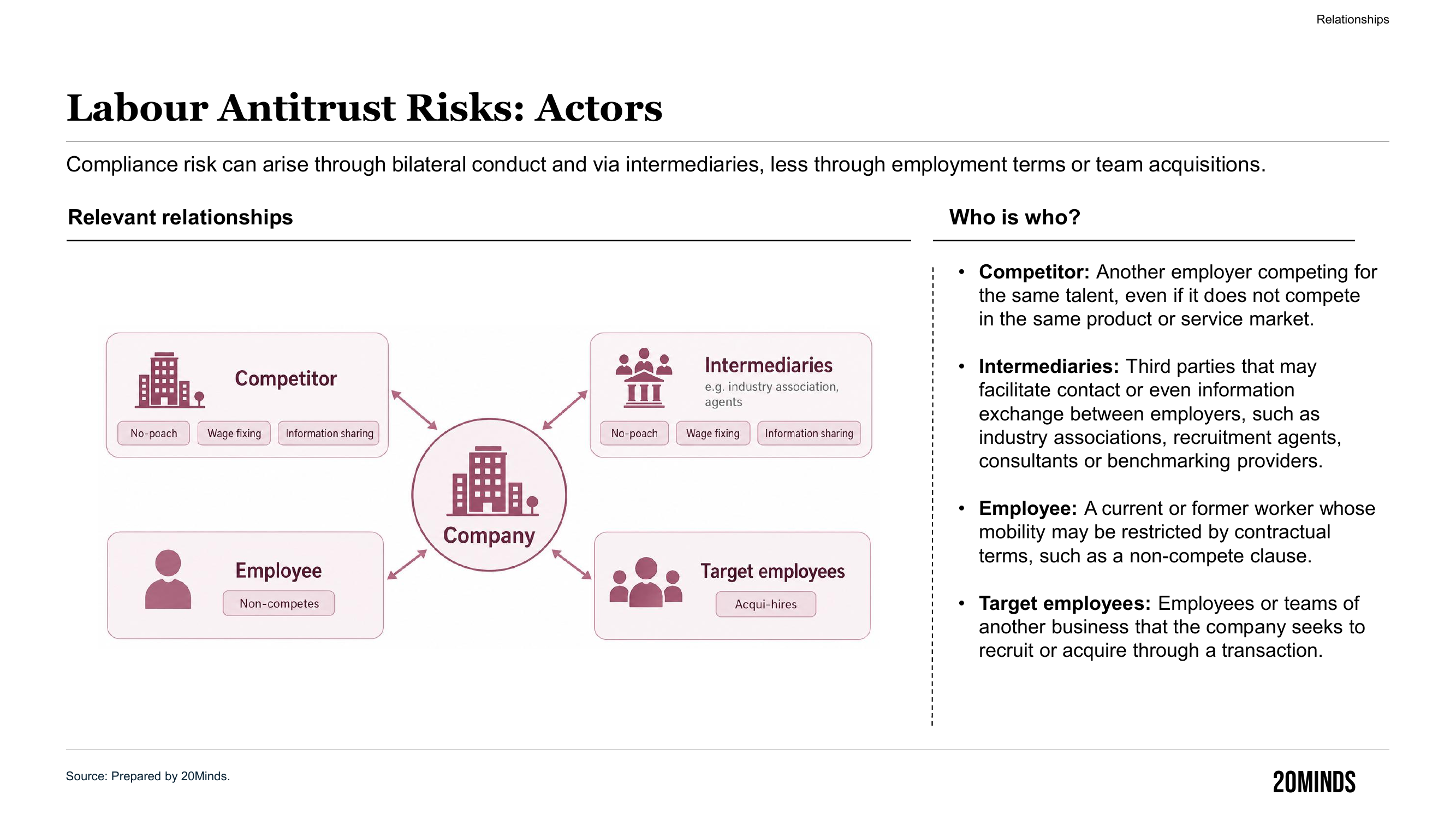
Risk can also arise indirectly. Recruiters, consultants, survey providers or industry associations may act as intermediaries through which competitors gain insight into each other’s practices. This is often described as a hub-and-spoke risk, where a third party facilitates alignment or signalling between competitors.
Provided effective controls are in place, a relatively safe approach is for the third party to:
- collect and process the data independently,
- keep individual company data confidential, and
- share results only in aggregated and anonymised form, based on sufficiently large data sets.
Julie: These considerations also apply to algorithms and benchmarking tools. Where companies rely on HR systems that operate on common datasets or algorithm-based benchmarking solutions, there is a risk — and also an emerging focus for regulators — that these tools may facilitate alignment in HR practices, depending on how they are designed and the data they use.
Companies using HR systems, compensation tools or algorithmic benchmarking solutions should know what data is used and whether outputs could reveal competitor-specific pay or hiring practices. How to safeguard this practically? Conduct due diligence on the vendor and its systems, then restrict contractually. For example, contractually limit the vendor’s use of company data and require regular audits to assess that the tool produces results that are sufficiently aggregated and anonymised. (Editorial Note)
From an enforcement perspective the picture is now clear — but where should companies start building out their compliance program?
Julie: Companies should structure compliance programmes to address the highest-risk areas first.
The starting point is to identify where competition for talent exists. This is what antitrust lawyers refer to as the Relevant Market. This requires looking at:
- the candidate perspective (who is suitable for the role), and
- the geographic scope (local, regional, or global).
A key point is that labour market competitors are not always the same as product or service competitors.
Example: an IT company may compete with companies in other sectors for accountants, HR professionals or lawyers.
Compliance and HR functions therefore need to assess competition from a talent perspective, not only from a product or service perspective.
In concentrated labour markets, even limited information can be revealing. Where only a small number of employers operate in a given segment, details such as role, location and salary range may allow competitors to infer which company is hiring and its pay strategy. This can make such information commercially sensitive. In more fragmented markets, the same information may be less revealing.
Example: in specialised semiconductor manufacturing clusters, where only a handful of major employers operate, sharing anonymised data on engineer roles, shift patterns and compensation bands may still allow competitors to identify the hiring company and anticipate its workforce strategy. Conversely, in large legal markets such as London, the number of firms can make identification more difficult, although certain segments may still exhibit high levels of transparency and standardisation.
The key question is whether the information enables competitors to infer another company’s compensation strategy. That assessment is highly fact-specific.
Anna: I would add that concentration in the recruiter or agent market can also increase risk. Where a small number of recruiters cover a specific labour market, they may hold detailed information on multiple competitors. In such cases, involving a third party can increase rather than reduce risk and result in hub-and-spoke type arrangements, depending on how information is handled.
Risk is generally lower where:
- the recruiter market is more dispersed, and
- recruiters operate as generalists across sectors, rather than specialising in a narrow segment.
The more concentrated and specialised the recruiter market, the greater the need for caution. But appropriate safeguards are required in any case.
Once you know where competition takes place, you want to understand how the company competes for workers in practice: how wages are benchmarked, how recruiting decisions are made, what restrictive covenants are used, what information is exchanged with peers, and where HR or business teams interact with other employers. When that factual baseline is clear, the company can start building meaningful controls — such as training, approval workflows, contract review, information-sharing guardrails, and escalation procedures — around the specific areas of risk. (Editorial Note)
So, what should be included in a compliance playbook?
Julie: At a minimum, companies should define clear do’s and don’ts covering the core risk areas:
- no-poach agreements,
- wage fixing, and
- information exchange.
HR teams often have limited exposure to antitrust compliance, so targeted training is essential.
HR should also be familiar with reporting channels and relevant legal and compliance contacts, and be encouraged to reach out for support in case of questions.
Training should also extend, where appropriate, to external recruiting agencies and search firms, compensation consultants and other external HR support providers who handle sensitive employment-related information on the company’s behalf or interact with competitors. (Editorial Note)
In higher-risk markets, companies may want to consider mapping HR’s external interactions, including:
- which events HR teams attend;
- who they interact with; and
- whether those interactions are role-specific or industry-wide.
Lastly, antitrust counsel should review how salary surveys and benchmarking exercises are conducted, given the associated information exchange risks.
Anna: I recommend tailoring training to different HR functions. Different HR teams engage with different labour markets, for example:
- senior management hiring,
- support functions, and
- blue-collar roles.
Each may present distinct risk profiles.
Some companies may decide, for better control, to implement pre-clearance procedures for:
- direct contacts with competitors; and
- interactions involving recruiters or other intermediaries.
Julie: It is also important to involve lawyers responsible for drafting employment-related agreements, such as:
- non-competes,
- NDAs, and
- other employment clauses.
As enforcement evolves, companies may develop alternative mechanisms to avoid prohibited conduct. These alternatives can themselves raise competition concerns if not carefully designed. Lawyers involved in drafting and reviewing such clauses should therefore be aware of antitrust risks and be kept up to date on developments on the enforcement front.
20Minds thanks Anna Huttenlauch and Julie Vandenbussche for their candid observations.
We also thank Benjamin Yrun Ostapuk, Emma-Jane Price, Kirstie Nicholson, Dr. Rachel Alemu, Radosław Pawluk, Rossella Torraca and other 20Minds members for their editorial advice.